

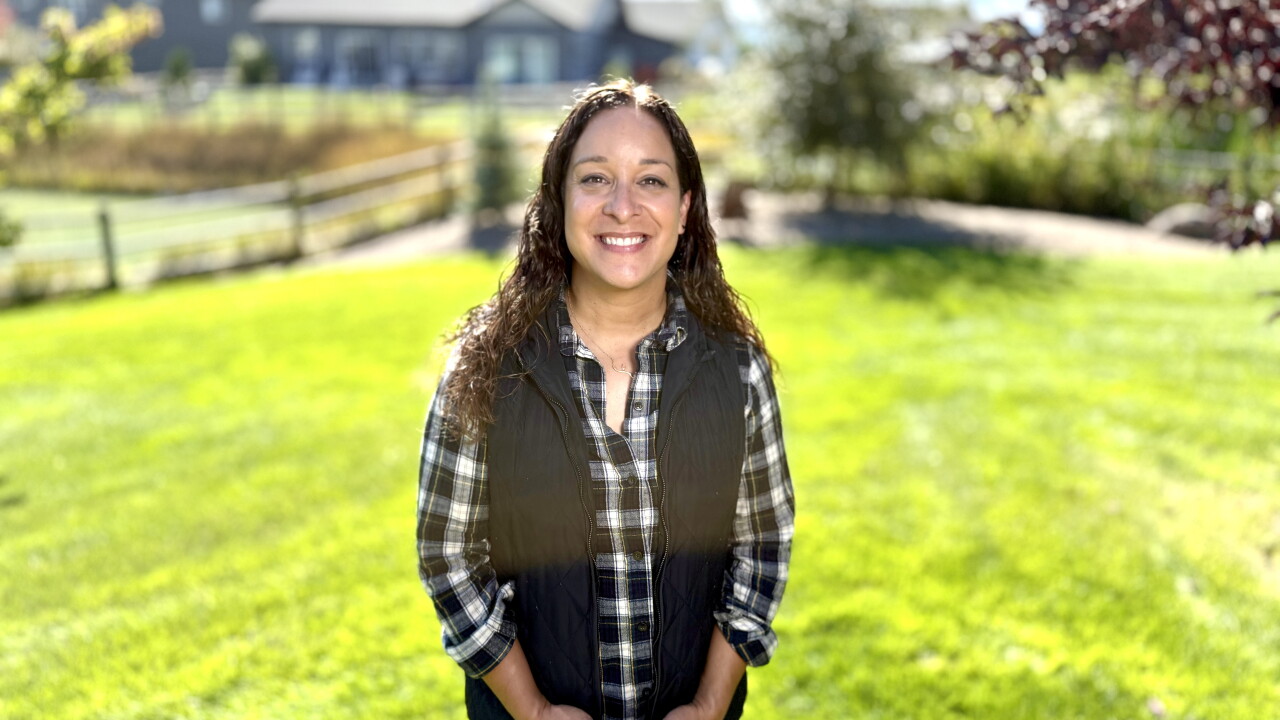


HELENA, Mont. — Alani Bankhead says, when she first moved to Montana, what stood out to her was the feeling of community.
“That's the thing that we love about Montana most, is neighbors take care of neighbors,” she said. “That's something we looked for our whole careers and have only really found it here.”
MTN met with Bankhead, the Democratic nominee for Montana’s U.S. Senate seat, in her neighborhood outside Helena.
(Watch the video to hear more from Bankhead.)
Bankhead, 44, spent much of her childhood moving to different states and countries, while her father was in the military. She then joined the Air Force herself, and she continued moving for years while she and her husband served.
Bankhead says her first introduction to Montana was working around Malmstrom Air Force Base while providing security for a top Air Force official.
“The thing that struck me was people waving to each other on side roads, which is something that my husband and I – you know, we'd wave to our neighbors and they mostly never waved back, and we thought that that kind of community didn't exist,” she said.
When her husband retired in 2021, their family came to the Helena area. Bankhead had previously worked for an international anti-human trafficking nonprofit and for the Hawaii Attorney General’s Office on a task force investigating online crimes against children. In Montana, she began working full-time on Mighty Sparrow Coaching, a leadership development business.
Bankhead says some people have asked why she wants to represent Montana in the Senate so soon after moving here, and why she didn’t start by pursuing lower office first. She says, having worked in Washington, D.C., and having existing relationships within the federal government, Congress was the right place for her to serve the state.
“I completely get people's frustration with the fact that I'm not from here, but the travel and the government experience is what gives me the breadth of understanding, and it also gives me the lens to see how special Montana values are,” she said.
This year’s Senate race has been marked by a split among Democrats. Some of the state's most prominent Democrats, including former U.S. Sen. Jon Tester and former Gov. Steve Bullock, have thrown their support behind Seth Bodnar, running as an independent rather than their party’s nominee. Bodnar is also getting endorsements from groups like Planned Parenthood Action Fund, Montana Conservation Voters and the Montana Federation of Public Employees that have often backed Democrats in statewide elections.
Bankhead says the groups that have lined up against her are tied to the “traditional Democratic establishment,” and that she’s happy not to be part of a system she says hasn’t been working.
“I actually love that we're not getting those traditional endorsements, because it shows that we can't be bought and paid for,” she said. “It shows that we're still showing up and fighting, it shows that we're only beholden to the people – and that's the kind of campaign I want to run.”
Bodnar and his allies have sought to question Bankhead’s Democratic credentials, particularly by accusing her of belonging to a “pro-MAGA” church while living in Virginia. Bankhead told MTN she had gone to the church, but she had never heard anti-LGBTQ sentiments there and would not have stayed if she had.
"I'm a spiritual person, but I haven't been to church in a long time because I see the damage that religious entities do and people who use religion to control communities, how they abuse that power,” she said. “So it's really hard for me to physically walk into a church. I have my personal belief system, and I practice in a way that's unique to me. I do think it's really hilarious that that's what they're going with.”
Recent polling has generally shown Bankhead in third place, relatively close to Bodnar, but both well behind Republican candidate Kurt Alme. During the summer, a number of Montana Democrats expressed concerns that having both Bankhead and Bodnar in the race would split the vote and make it essentially impossible to defeat the Republican. But Bankhead says she still believes there is still a path to victory, and she’ll keep working to connect with Montanans at the grassroots level.
“You can have your plans, you can have your data, but at the end of the day, the people are going to decide on Nov. 3, and they will make their choice known,” she said.
See Alani Bankhead’s extended answers on specific issues:
The following interview has been edited for brevity and clarity.
Should the federal government be putting more restrictions on data centers?
“I absolutely do think that they should, because it is a matter of public interest and public safety. There is too much happening in terms of utility costs, the public land conversation and the environmental impacts. Government’s job – one of the their jobs – is to ensure that the majority of the public is as safe and taken care of as possible, and there's just too many unknowns at this point. Montana, unfortunately, has a terrible history of corporations coming in and destroying the land and the environment and then taking their money with them and leaving the people and the taxpayers to clean up after them. And so I absolutely think that there's a place for federal legislators to at least do a moratorium before we can get the research and the guardrails in place to ensure that we're creating win-wins for everybody.”
Should local communities have an absolute right to say no to construction in their area?
“Yes, absolutely. I do think that they should have a say. In fact, they are the ultimate deciders in my mind. Montana cannot be governed from D.C., it can only be governed from the grassroots level. And Montanans have been very clear, whether Republican, Democrat, libertarian, vegetarian – nobody wants AI data centers and legislators aren't listening, and they should be.”
Are there actions Congress could be taking to help improve the supply of accessible, affordable housing in Montana?
“Absolutely. There are things that can happen at the federal level. So there are strategic goals that take a while to get done, and then there are tactical goals that can get done fairly quickly. And so, a big strategic goal is getting private equity out of housing, because obviously these corporations are coming in and driving the cost of housing up. Unfortunately, a lot of our congresspersons are paid for by these lobbyists who actually don't want that system to change. At the tactical level, there are things we can do like, the capital gains law is an incredible law that both sides of the aisle love, it was passed in the 90s, hasn't been updated. And so something as simple as raising that capital gains exclusion from $250,000 to $500,000 has been really well received around the state, and that's an example of one small way where, when people can sell their houses without paying taxes on it, that creates more inventory, which actually drives the cost of housing down, which ultimately drives rent down, if you're renting that house out. And so we have policies on our website that talk about those little incremental changes that we can make so that we can start getting the price of housing moving to be more affordable.”
Are you supportive of the more aggressive federal immigration enforcement we’ve seen under the Trump administration?
“I'm a retired federal law enforcement officer, I was a Homeland Security task force officer, so what that means is I went through their training, I carried their badge and credentials, I understand how the border works. I believe in law enforcement and the rule of law, I believe in strong borders – I haven't met anybody on any side of the political aisle that isn't for having a safe and secure country. I think first and foremost that there's a lot of political rhetoric at the D.C. level that is keeping us divided, but Montanans across the 54 counties that I've been to are pretty well united on the fact that we want a safe community. Now, in terms of how ICE is handling things, they completely need to go away and be rebuilt into something different. Unfortunately, there's a lot of things happening. No. 1 is, their hiring has been relaxed in terms of who they're willing to take. On the federal law enforcement side, you have very high standards for who we’ll accept, because when you're given a badge and a gun, you are expected to wield it with integrity and excellence. And we have deaths that have happened at the hands of ICE agents. They are going after individuals that actually do have protections because of green card status or citizenship. They are very sloppy and they're being targeted – the whole point is for them to target these immigrant communities. And No. 1, we are a nation of immigrants, so unless you're Native American, your ancestry at some point came here. The beauty of our country is that we have folks with such diverse backgrounds, and that's where the ingenuity and brilliance of the American system comes from. It comes from the people. On top of that, the way that the Department of Justice and the administration have been using that tool, the issue is, if you're breaking the law, you will be held accountable to that. The issue is that they're violating the due process, and so if they violate the constitutional rights of one person, they're going to do it to U.S. citizens, they're going to do it to the rest of us eventually. So we're already seeing elements of that, and it's just really unacceptable. But I do think that there's opportunity here because it's creating this conversation that we have to have and this reckoning in terms of who we are as a country and who we want to be moving forward. I think that Montana is very community oriented. We saw in Froid, right? A whole community rallied around their individual – and not excusing the fact that he's overstayed his visa or whatever the legal issues were, but at the end of the day, Montanans see the value of individuals and community, and they're going to back each other up.”
Do you think the Trump administration’s tariff policy has been successful?
“It has not been a success. In 2025 alone, each Montana household spent about $1,000 on tariffs. Tariffs actually violate the Native American treaties, right? So when we treat our Native American brothers and sisters as sovereign entities, the fact that they now cannot engage in trade across the Canadian border especially, and the fact that they're being taxed on this level is a violation of that sovereignty and those treaties. So it impacts everybody – not only Native Americans, but obviously, affordability is the number one issue. We hear everywhere about how expensive grocery and gas is, and people aren't spending, in terms of just going out and having a good time, because there's not any money left over. It breaks down relationships with our trade partners, other countries. We usually have a win-win situation with our foreign counterparts, but Trump, unfortunately, is just creating a lot of havoc in that space. And not only is it impacting our standing on the world stage, but it hurts our pocketbooks.”
Should anything be done to help Montana businesses who say they’ve been harmed?
“Absolutely. Congress needs to check the executive, and that's one of the first things I'm going to do. One of the main cornerstones of my platform is accountability, and Congress has ceded too much authority to the executive. And so, ensuring that the executive understands that the power of the purse actually belongs to Congress and nobody else, and ensuring that Congress is doing what's in the best interests of the people. Right now, unfortunately, people are just struggling in terms of just being able to make ends meet, and so, I absolutely would vote to push back as much as possible. And the reality is, nationally, we're seeing candidates come up with these populist ideas because the people are fed up with it.”
Do you want to make any changes to the tax policy Congress passed in the “Big Beautiful Bill” last year?
“We absolutely need tax reform. First of all, the tax system is overly complicated, and that allows billionaires and corporations to pay their big-time CPAs so that they can find those loopholes. Ultimately, we have to have the wealthy pay their fair share, so I'm a big proponent of a wealth tax. I also believe that they need to pay their fair share on Social Security, so removing that income limit on that would help fund Social Security in perpetuity, and additional programs such as caretaker programs. Yes, ultimately, we absolutely have to restructure the tax system so that the billionaires aren't getting out of paying taxes altogether.”
Do you want to see further changes to eligibility requirements for benefits like Medicaid and SNAP?
“That's really interesting. On the Medicaid side of things, I'm a proponent of universal health care. I've talked about TRICARE, the military health care system – it's a government-run health care system. So if we were to implement a system like that, there wouldn't be eligibility requirements – everybody would be covered. In terms of other benefit programs, we do have to ensure that we are being the best stewards of taxpayer dollars as possible, and that's why programs like fraud prevention and fraud accountability are so important. You know, it's interesting: My agency handles fraud. I was not a fraud expert, but obviously I dealt with some fraud investigations. And since the beginning of my career, it was interesting seeing how judges and those accountability folks really did not bring the hammer down when we were able to prove fraud – you know, they're like, ‘Well, it's just money,’ or, ‘This person has really great standing in the community,’ so we're going to kind of let them off the hook for those kinds of things. That's why inspectors general exist, that's why we have other accountability entities. I know something within the federal law enforcement space we've wanted for a long time is just a bigger hammer and more accountability, because right now we have two Americas and two Montanas. You have the one for the 1%, where the rules are completely different for them as compared to the rest of us. Montanans don't ask for a lot, but we do expect a free and fair democracy, and that means that everybody needs to be held equally accountable across the board.”
Social Security is projected to be unable to pay full benefits by 2032. How should Congress respond?
“Remove the income limit on Social Security; it's what the people want. These are entitlements, right? People pay into these programs. Unfortunately, Congress in the past has just been kicking the can down the road. They'll borrow out of Social Security and do these things, and it's unfortunate that so many legislators think short-term – they think about their votes and their reelection bids. They're not thinking about the long-term health of that program. And that program is absolutely critical, especially now with affordability being as difficult as it is. Our senior citizens have worked decades just busting their butts to provide for their families and serve their communities. We all deserve to retire with dignity.”
What role, if any, should the federal government play in regulating abortion?
“I believe that government should stay out of medical decisions. I think that those decisions are between the health care provider and the patient.”
Do you support the Trump administration’s decision to repeal the nationwide Roadless Rule?
“I'm completely opposed. This is a clear play to open up our public lands to be exploited and to put AI data centers on them – which, over my dead body will they do that. Our public lands are the nation's crown jewels, and every Montanan knows and understands that. Once they're gone, they're gone. Slowly over time, they've been making these inch movements towards opening up that land for exploitation, and unfortunately, our current congressional delegation is supporting it. And so, I'm completely opposed to it. That's one of the reasons why I'm running, is because it's frustrating that legislators aren't listening to what the bulk of constituents want, and Montanans want to protect their public lands, Montanans don't want AI data centers, Montanans want accountability of corrupt government officials – and that's just not happening right now.”
Do you want to see changes in how the federal government manages federal lands?
“I certainly did not like the recent moves, where they decentralize that federal control and they're moving more towards having states being responsible for them. I think that's another ploy to open them up for exploitation. Governments partly exist to ensure that safeties and guardrails are put in place. So I think right now our public lands are under attack, and the federal government needs to be ensuring that we are protecting those lands.”
How do you think the U.S. should be approaching the ongoing conflict in Iran and the Middle East?
“I'm completely opposed to the war in Iran, and I say that as a retired Air Force lieutenant colonel and counterintelligence agent. We shouldn't have been in that war to begin with. Even Tulsi Gabbard, the director of national intelligence at the time, said that there was no intelligence pointing to imminent acquisition of a nuclear weapon by the Iranian government. I think it's a distraction from the Epstein files and a bunch of other things. It's costing us almost $2 billion a day to fund this war in an economy where we don't have that kind of money – and it's taxpayer money. So I would fight to end that war in Iran, I would support the War Powers Resolution, I support more accountability of the executive at this point, because we have service members that are dying over there. Conscientious objectors are up an insane percentage. As a service member, you fight for your country because we love it and we want to protect it – and America's got her flaws, but she’s still the greatest country in the world in my opinion. So putting us in this quagmire kind of situation with Iran is unfortunate, and it's going to take us years to rebuild relationships.”
See other candidate profiles:
Kurt Alme draws on Montana roots in U.S. Senate campaign
Kyle Austin touts business experience in bid as Libertarian for U.S. Senate
Liberal in disguise? Independent Seth Bodnar pushes back, 'not sure' if Bankhead more left-leaning
