

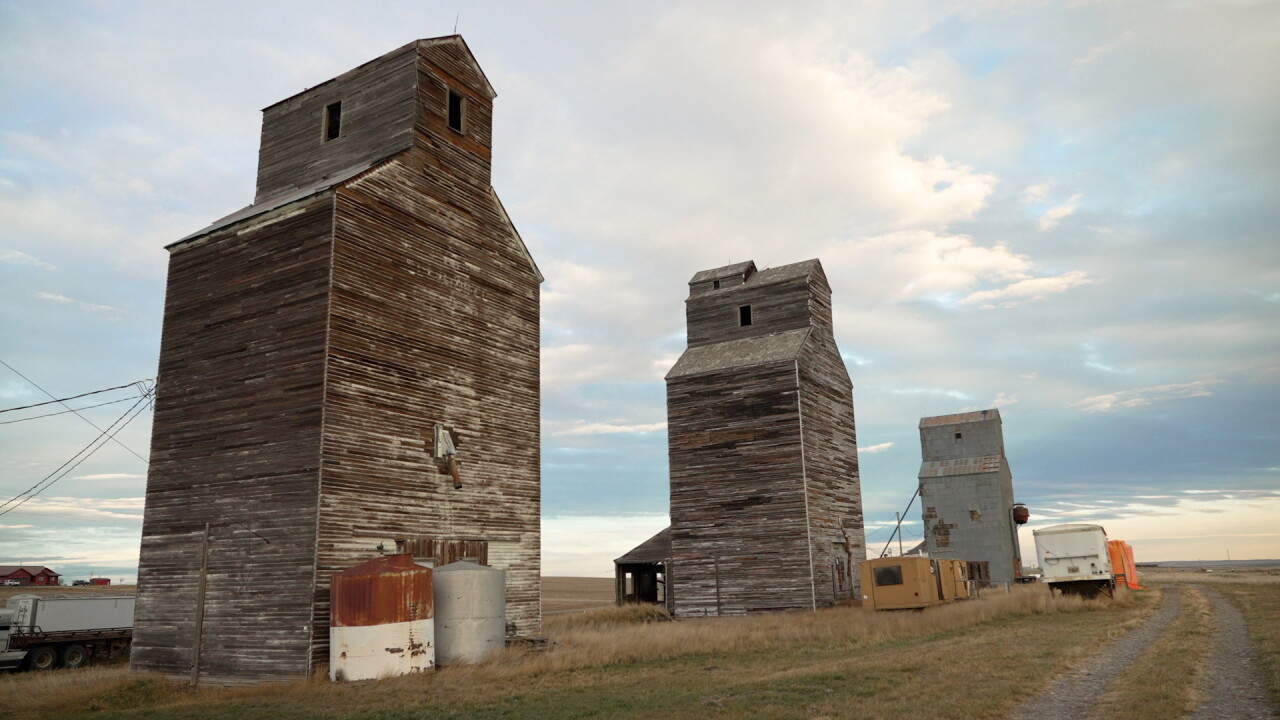

BILLINGS - For generations, grain elevators have towered above Montana’s small towns, connecting farmers to the world beyond them. Today, some are still essential to agriculture. Others are disappearing, while communities across the state search for ways to preserve and reinvent the landmarks that helped define them.
Watch the full half-hour special below:
They rise from Montana’s landscape almost like exclamation points.
Beside railroad tracks. At the edge of small towns. Sometimes seemingly alone on an open stretch of prairie.
Some have stood for more than a century. Others are showing their age, with weathered boards, battered roofs and openings where windows once were.
Montana’s old grain elevators were never meant to become monuments. They were working buildings, constructed to solve a practical problem: getting a farmer’s harvest from the field to markets hundreds or even thousands of miles away.
In the process, they helped build communities.
For decades, grain elevators served as gathering places during harvest, landmarks for travelers and critical links between Montana farms and the national economy. Farmers brought grain by wagon and later truck to be weighed, sorted and stored. Inside, buckets attached to a moving belt carried grain to the top of the structure. Gravity then moved it into bins below, which is how the grain “elevator” got its name.
Their location was just as important as their design. Elevators rose beside railroad tracks so grain could be loaded into railcars and shipped to mills, terminals and markets far beyond the communities where it was grown.
In Rapelje, that relationship is still written across the skyline. Just 88 people live in the community, but four grain elevators remain. The town grew as a railroad community during Montana’s homesteading boom. The railroad was removed in 1980. The elevators stayed.
That contrast is at the heart of MTN’s half-hour special, Montana’s Silent Giants, a journey across the state exploring what these structures meant, why so many are disappearing and what comes next.
Built to last
Many of Montana’s historic elevators are remarkable not only because they survived, but because of how they were built.
Traditional wooden elevators often used a construction technique known as cribbed lumber, with boards stacked horizontally and interlocked in a way one Missoula business owner compared to Lincoln Logs. The design helped the structures withstand the enormous outward pressure of stored grain.
The amount of wood could be staggering. The lower crib portion of some elevators required roughly 300,000 board feet of lumber, stacked in overlapping layers almost like a massive log cabin.
Many appear to be metal buildings, but wood is often hiding underneath. Information compiled for the special notes that protective metal siding became common in part because sparks from passing trains could ignite grass fires and threaten wooden structures. A typical historic wooden elevator could hold tens of thousands of bushels of grain.
That construction helped some survive a century of Montana weather.
But surviving the elements does not necessarily mean surviving a changing agricultural economy.
When a landmark disappears
Agriculture became more mechanized. Farms grew larger. Transportation changed. Grain storage changed along with it.
And many of the small wooden elevators that once made economic sense no longer did.
In Havre, two historic elevators came down last year even though BNSF trains still run through the Hi-Line community. One had roots stretching to 1912. Historic tour operator Emily Mayer, who grew up seeing the structures, compared their loss to“losing an old friend.”
The history was about more than architecture. Havre Mayor Wade Bitz noted that building the elevators once meant jobs and demand for materials from local merchants. Modern agricultural facilities, he said, now handle crops ranging from grain to peas, flax, chickpeas and mustard.
Other elevators have disappeared more suddenly.
A 2023 wildfire destroyed all four elevators in Denton, dramatically changing that community’s familiar skyline. Another elevator burned in Wolf Point, while an old elevator in Cascade was deliberately brought down years earlier.
The losses help explain why preservation has become increasingly urgent in some communities.
Saving one isn't simple
In Hobson, residents rallied to prevent two historic elevators dating to 1908 from being demolished.
The group Pride of the Judith raised money through donations and fundraisers, even turning to a special beer brewed for the cause. A $5,000 Montana History Foundation grant helped, but additional work has been slowed while organizers navigate a property lease with BNSF and liability concerns.
The lesson is one repeated elsewhere in Montana: stopping the wrecking ball is only the beginning.
In Livingston, residents stepped in after wind badly damaged the historic Teslow Elevator in 2016 and demolition began. The 75-foot structure survived, but its supporters then faced the much harder question of how a century-old grain elevator could have a sustainable future.
A second Livingston project provides one possible answer. The century-old Yellowstone Granary sat vacant for years before developers transformed it into 17 apartments, preserving part of the character of the original agricultural building while giving it an entirely different purpose.
Reinventing a silent giant
Across Montana, the answer to what comes next looks different in nearly every town.
In Missoula, the Ceretana Feeds complex, built in 1929, has been repurposed as an art and business hub rather than being demolished after its grain-moving days ended.
Near Bozeman, another old elevator has been converted into a five-story residence. In Hinsdale, the building itself is disappearing, but its materials are not. Old elevator lumber is being salvaged board by board and given new life in floors, walls and homes.
And in Glendive, reinvention has occurred on an even bigger scale: an elevator has become a massive public-art canvas, an attempt to use one of Montana’s old agricultural landmarks to attract attention and visitors rather than simply allow it to disappear.
The elevators have also become subjects of art themselves.
Montana photographer Bruce Selyem has amassed roughly 80,000 grain-elevator images from thousands of locations across the United States and Canada, documenting structures that may not always remain standing.
It is another kind of preservation: saving an image when saving the building may no longer be possible.
Not all of the giants are silent
It would be easy to tell the story of Montana’s grain elevators entirely in the past tense.
That would also be wrong.
At the Molson Coors operation in Huntley, large modern elevators still perform essentially the same job elevators have performed for generations: receiving grain from farms, storing it and getting it where it needs to go.
The difference is scale.
Four elevators there stand roughly 100 feet tall and hold millions of pounds of barley. The operation grew after large flat-storage buildings were purchased in the 1970s, connecting a century-old idea to the modern agricultural economy.
As regional manager Cody Shick put it, the machinery and bins may be newer and bigger, but the mission is remarkably familiar: move the harvest from the farm to where it needs to go.
And in this case, a lot of that barley eventually becomes beer.
“It's an awful lot of beer, I'll tell you that,” Shick joked.
More than old buildings
That may be what makes Montana’s grain elevators so enduring.
They were utilitarian buildings that became landmarks almost accidentally.
They stored grain, but they also marked towns on the horizon. They connected isolated farms to railroads, markets and the wider world. Their construction created jobs. Their operation brought farmers together. And generations later, their silhouettes still identify places that grew up around them.
Now Montana is deciding what happens when that original job disappears.
Some will continue working.
Some will be restored.
Some will become apartments, businesses or art.
Some will be carefully dismantled so their century-old lumber can live somewhere else.
And inevitably, some will disappear.
For Bruce Selyem and Barbara Selyem, who document historic elevators through the Country Grain Elevator Historical Society, even the deteriorating ones have something worth preserving.
As Bruce said while exploring the elevators at Reed Point, “They're trying to tell a story... that we may never know.”
They have been silent for a long time.
But across Montana, people are still listening.
