


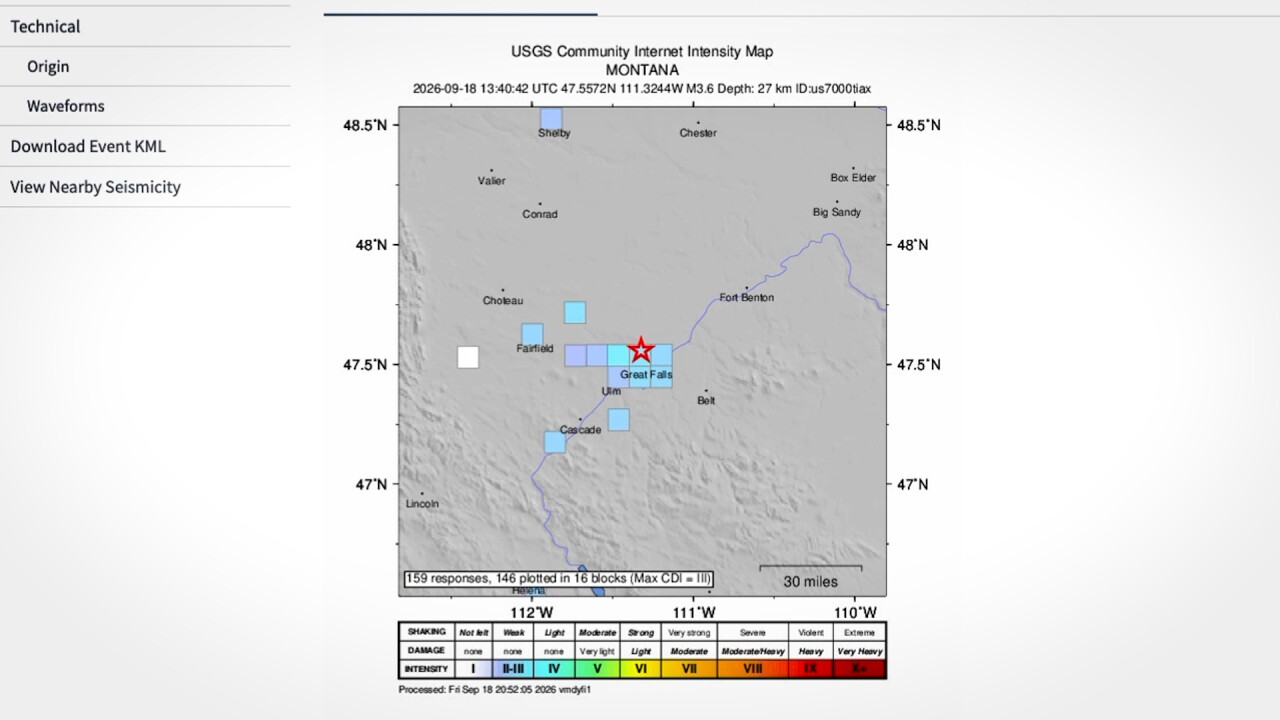
BLACK EAGLE — A magnitude 3.6 earthquake was recorded near Black Eagle on Friday, Sept. 18, marking the first earthquake in the Great Falls area in several months which was large enough to be widely felt.
Here’s what we know:
- The earthquake occurred at 7:40 a.m.
- It was centered about three miles northwest of Black Eagle and four miles from Great Falls.
- It originated at a depth of about 17 miles.
- More than 150 responses were submitted through the U.S. Geological Survey’s “Did You Feel It?” system.
- The Montana Bureau of Mines and Technology says there is no evidence that the area’s earthquake activity is escalating.
WATCH Madison Collier's report below:
About an hour after the earthquake, approximately 1,500 customers on the southeast side of Great Falls lost power.
According to NorthWestern Energy, the power outage was unrelated to the earthquake. The outage began around 8:53 a.m. and power was restored by approximately 10:05 a.m.
Following the earthquake, the company initiated its standard inspection procedures for its natural gas, electric and hydroelectric facilities. The company found no indications of earthquake-related damage and said it would continue monitoring its systems.
MBMG says Friday’s earthquake was likely part of the aftershock sequence that began with the magnitude 4.2 earthquake on Jan. 29.
Although Friday’s earthquake originated deeper than others previously recorded, MBMG says its depth alone does not indicate anything alarming. Instead, it indicates that the Earth’s crust at that depth is brittle enough to fracture and release energy.
“This event is consistent with the tectonic activity we expect to see in this region.” Andres Felipe Peña Castro, a research seismologist at MBMG, confirmed.
Additionally, while the most recent earthquake was the first widely felt seismic event in several months, it may not have been the first recorded for the region since February. According to the MBMG, recently installed monitoring equipment in the Great Falls area detected a magnitude 1.9 earthquake in April and a magnitude 2.4 earthquake in July.
“Our monitoring system has detected smaller, unfelt tremors in the area, including a magnitude 1.9 in April and a 2.4 in July, showing that there has been some minor activity ongoing,” he added.
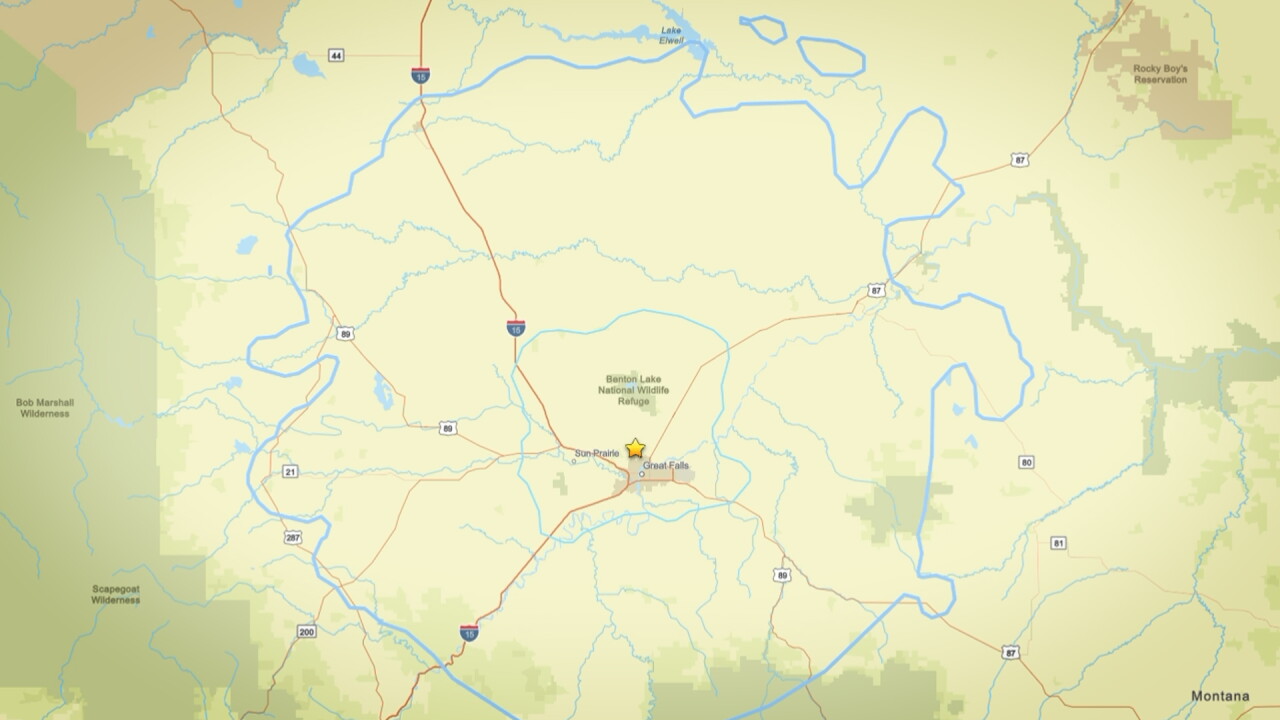
Since the earlier earthquakes, MBMG has installed two new seismometers in the Great Falls area. Both instruments were operating and recorded Friday’s earthquake.
Researchers there say having equipment closer to the earthquake sequence provides clearer data and helps researchers more accurately determine the locations and magnitudes. MBMG is also using machine-learning technology to detect smaller events that may have previously been missed, such as the April and July seismic events.
“These forecasts are statistical probabilities, not predictions,” said Castro. “While the probability of another felt event decreases over time, it never drops to zero immediately. There were no likelihood estimates for the one this morning as it is small in size.”
The bureau is looking for additional residents around Great Falls who may be interested in hosting a seismometer to help expand its monitoring network. Those interested can contact MBMG for more information.
