

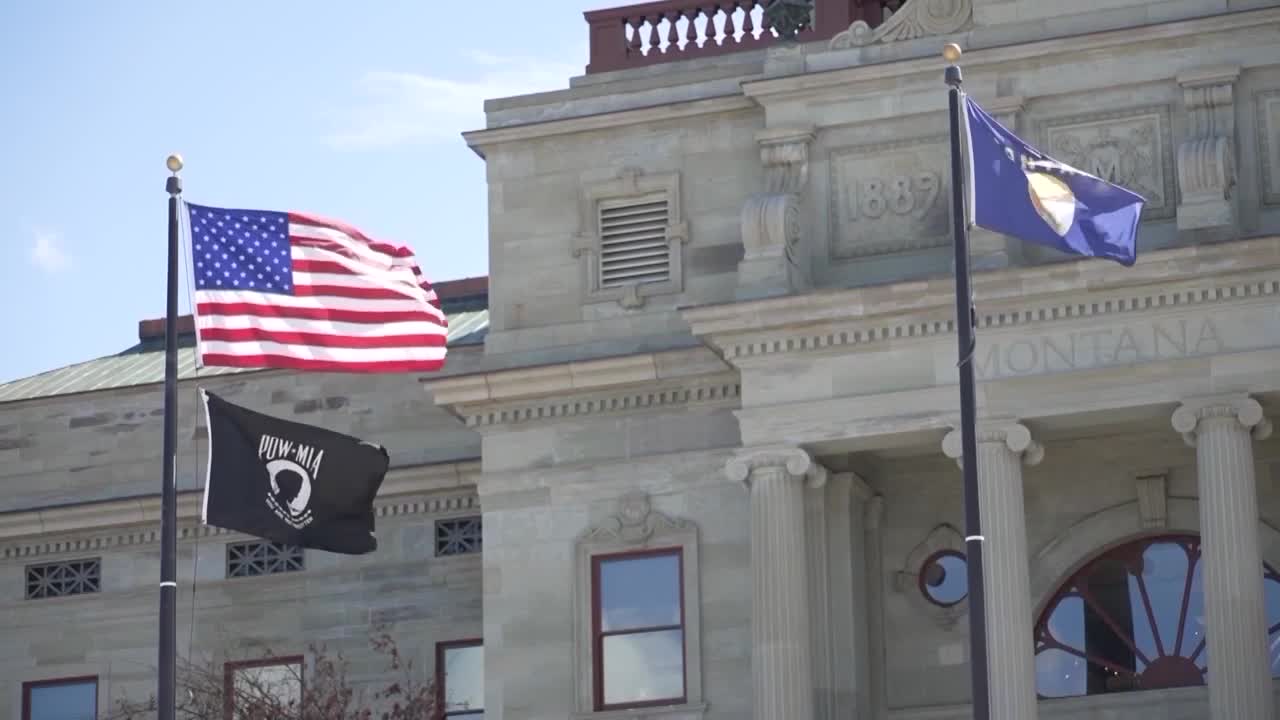


HELENA — 2026 is here, and that means Montana is once again in an election year. But chances are the election hasn’t felt as ever-present this time around. The state hasn’t been blanketed by the kind of advertising we’ve seen in recent election cycles.
“Montana is no longer in the front line of receiving the national money for our Senate seats – particularly the Senate seats in recent years – or statewide elections,” said Jeremy Johnson, a professor and chair of Carroll College’s Department of Political Science and International Relations.
(Watch the video for more on what to expect in Montana's 2026 elections.)
In 2024, Democratic Sen. Jon Tester’s race for reelection was considered perhaps the most important election in the country, behind the presidential race. It drew more than $250 million in campaign spending.
But after Tester’s loss to Republican Tim Sheehy, the GOP controls Montana’s entire congressional delegation – and has won every statewide election since 2020. With Republican Sen. Steve Daines up for reelection again in 2026, there hasn’t been the same level of outside interest.
U.S. Senate

National political forecasters, including the Cook Political Report, Inside Elections and Sabato’s Crystal Ball, have graded Montana’s Senate seat as “solidly Republican.” They’ve identified Senate races in states like Maine, North Carolina, Ohio, Iowa and Texas as being more competitive in 2026.
“Steve Daines has now been in the Senate for two terms, he's been an incumbent, so that, I think, national Democrats strategically think that's even harder,” Johnson said.
Daines, a close ally of President Donald Trump, was elected to the Senate in 2014, then reelected in 2020.
So far, four Democratic candidates have filed campaign finance paperwork, expressing plans to run against Daines:
- Reilly Neill, of Livingston, a former state representative and a 2024 write-in candidate for U.S. House
- Michael Black Wolf, of Hays, the Fort Belknap Indian Community tribal historic preservation officer
- Michael Hummert, of Helena, who ran in the Democratic primary for U.S. Senate against Tester in 2024
- Alani Bankhead, of Helena, an Air Force veteran and leadership coach
Additionally, another Republican candidate has also filed for the Senate race: Charles Walking Child, of Helena, who ran for Senate in 2024 and U.S. House in 2022.
In 2024, Trump won Montana by 20 points. Tester outperformed the national Democratic ticket by 13 points, but that wasn’t enough to change the result.
However, Johnson says there are indications that, with Trump’s approval rating having fallen and Democrats overperforming in special elections last year, the national political environment may not be as favorable for Republicans in 2026.
“What we’re seeing right now is the nationalization of politics, and that has not helped Democrats in Montana,” he said. “However, this election cycle, it very well may help Democrats nationwide – and even in Montana.”
Johnson said issues like affordability have contributed to weaker poll numbers for Trump. Still, he said the political climate may change by November.
“For a Democrat to win, you need a lot of things to align correctly: the national mood, sufficient resources to get your name and message out there – which does require money – and being a strong candidate,” he said.
U.S. House

Trump also won both of Montana’s congressional districts – but the result was much closer
The much more Republican
In addition, Michael Eisenhauer, a cardiologist from Great Falls, has announced plans to run for the seat as an independent. In order to get on the ballot, an independent candidate must get petition signatures from registered voters – 4% of the amount of votes cast for the winner of the last election, or 7,274 in this case.
State Offices
Most of Montana’s most prominent state offices – including governor – are elected in presidential election years, not midterms. There will only be one statewide office open in 2026:
an associate justice seat on the Montana Supreme Court, replacing the retiring Justice Beth Baker. Two district court judges from Flathead County, Dan Wilson and Amy Eddy, have announced they’re running for that position.However, there will be other elections of note at the state level. Two members of the Montana Public Service Commission will be up for election. Commissioner Annie Bukacek, R-Kalispell, will be seeking a second term representing the PSC’s 5th District, while Commissioner Randy Pinocci, R-Sun River, will be termed out and a new commissioner will be elected to fill his 1st District seat.
There will also be elections for 25 state senators and 100 state representatives. Already, Republican candidates are setting the stage for what could be heated primaries, with groups laying out sharp differences over issues like the Legislature’s 2025 property tax changes and judicial reform bills.
“There's no doubt that when one party starts dominating elections in the state, the primaries become more and more important,” Johnson said.
Because Montana does not require voters to declare a party in order to vote in a primary, there has often been speculation that voters who prefer one party could be voting in the other party’s primary to influence its candidates. Johnson told MTN that, in general, political scientists haven’t found “crossover voting” occurring to a significant extent.
“Even in solid states, people tend to vote with the party they identify with,” he said. “That doesn't mean that no one does it or anything like that – so in a very close race – but generally people in the primaries still, from what I've seen in the literature, when it's an open race, vote for the party that they most identify with.”
Voters could also see a number of ballot initiatives in November. There are currently six active campaigns seeking to qualify an initiative for the ballot in 2026, though several are held up in court and the rest won’t know if they’ve collected enough signatures to qualify until the summer.
In previous election cycles, candidates would begin officially filing for the ballot in early January. However, the Legislature passed and Gov. Greg Gianforte signed House Bill 207 last year, which shortened the filing period from two months to two weeks. That means 2026 candidates will need to file with the Secretary of State’s Office between Feb. 17 and Mar. 4.
