

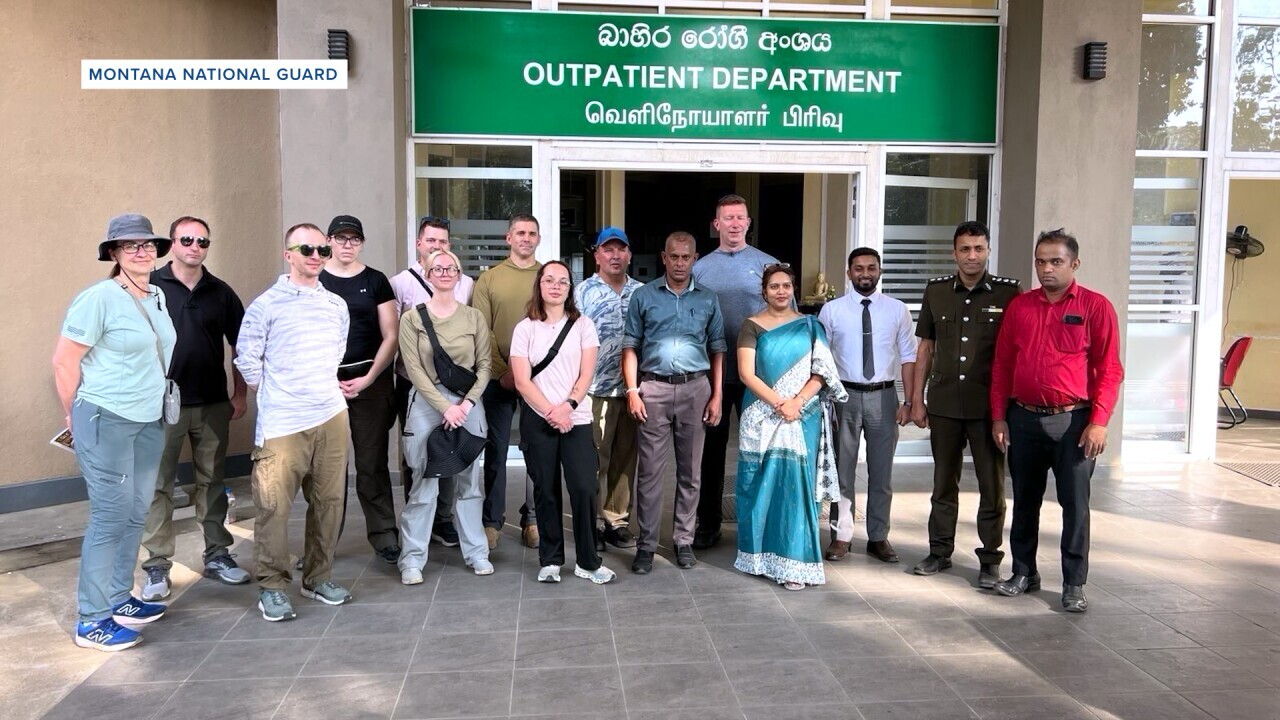


MALMSTROM AIR FORCE BASE — A team from the Montana National Guard has returned home after deploying to Sri Lanka to help assess damage following Cyclone Ditwah, which tore across the island nation in November 2025.
Madison Collier reports - watch the video here:
The powerful storm washed out roads, collapsed bridges, destroyed schools and left entire communities isolated in mountainous regions of the country.
Two months after the cyclone made landfall, a seven-member team from the 219th RED HORSE Squadron traveled overseas to conduct site assessments and help determine what recovery efforts are most urgently needed.

“For this particular site assessment, it's the initial look at what is the problem,” said Lt. Col. Kevin Ochs, deputy commander of the 219th RED HORSE and the officer in charge of the mission’s engineering team. “If you repaired this bridge, what would it do for the community?”
Over the course of ten days, the team evaluated 26 different project sites. Many were located in steep, mountainous areas where landslides had wiped out critical infrastructure.
“There were communities who are six kilometers of road totally gone with bridges, schools destroyed… and there's still 110 kids not in school and it's been over two months,” Ochs said.

Senior Master Sgt. Nicholas Hackett, the senior non-commissioned officer on the mission, said in some areas, residents had to travel long distances just to reach basic services.
“We had one location that we went to that they had to go six kilometers to get to a paved roadway to be able to get medical care,” Hackett said.
At some sites, residents relied on boats after bridges were washed away, and some single-lane roads served as the only connection between entire communities and the outside world.
“If they don't get fixed, these communities can be completely cut off from the outside world,” Hackett said.
The team documented GPS coordinates, took measurements, photographed damage, and estimated repair costs. Their findings will now be sent to the U.S. Embassy and State Department, where they will be evaluated alongside other humanitarian projects worldwide to determine funding priorities.
Col. Jennifer Cinq-Mars, commander of the 219th RED HORSE Squadron, said the team’s unique combination of military and civilian expertise plays a key role in missions like this.
“We have these folks with their civilian experience providing site assessments to help that community get back on their feet, or at least have a plan to get back on their feet,” Cinq-Mars said.
What does RED HORSE mean? Rapid Engineer Deployable Heavy Operational Repair Squadron Engineers
While the mission focused on humanitarian support, she says it also serves another purpose: readiness.
Members of the Montana National Guard routinely respond to emergencies at home, including floods, wildfires, and severe winter weather. Cinq-Mars and Ochs explained that conducting assessments overseas sharpens those same skills.
“It's good training, real-world training for us,” Ochs said. “Not only what we can do to help the Sri Lankans, but also what we learned going there and doing the assessments.”
The deployment was part of the State Partnership Program, which pairs U.S. states with partner nations to build long-term relationships and strengthen emergency response capabilities.
Through years of engagement, Montana and Sri Lanka have developed working relationships between engineering and disaster response teams, something Cinq-Mars says makes a difference when crises happen.
“When you have the same engineering staff from Sri Lanka or some of these other countries working with our engineering staff, you're not spending time building the trust because it's already there,” she said. “So you just start focusing on the mission and the work. And that's that community sense.”
For Hackett, this was his second trip to Sri Lanka. Despite the devastation, he said what stood out most was the resilience of the people.
“The people over there are amazing,” he said. “Everywhere you go, you see devastation… and everybody there is smiling and happy and just glad that they're alive.”
The assessments completed during this mission will now help guide future recovery projects in Sri Lanka. At the same time, leaders with the Montana National Guard say the experience strengthens the state’s own emergency preparedness, reinforcing the idea that humanitarian service abroad can directly benefit communities at home.
